FASHI
The FAST All-Sky H I Survey
read as /fɑːʃ/ or “法师”
Overview
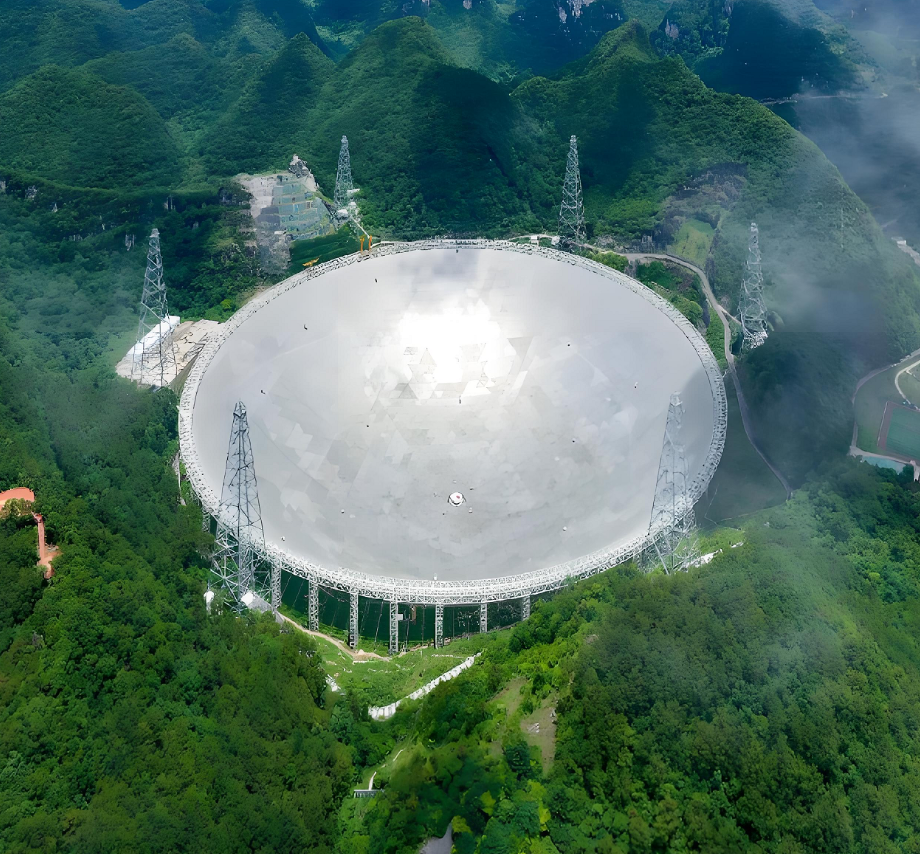
The FAST All-Sky H I Survey (FASHI) is a pioneering neutral hydrogen (H I) survey conducted using the Five-hundred-meter Aperture Spherical radio Telescope (FAST), the world's most sensitive single-dish radio telescope. FASHI represents the first all-sky H I survey undertaken with FAST, leveraging the telescope's unprecedented sensitivity and wide field of view to conduct a comprehensive census of neutral atomic hydrogen in the local Universe.
Neutral hydrogen is the fundamental building block of galaxies, serving as the primary reservoir of fuel for star formation. Mapping the distribution and content of H I across the sky is essential for understanding the formation and evolution of galaxies, the growth of large-scale structure, and the cycling of baryonic matter in the cosmos. FASHI is designed to detect H I emission from galaxies out to redshifts z < 0.09, probing the local Universe with a sensitivity and source density that far surpasses previous surveys.
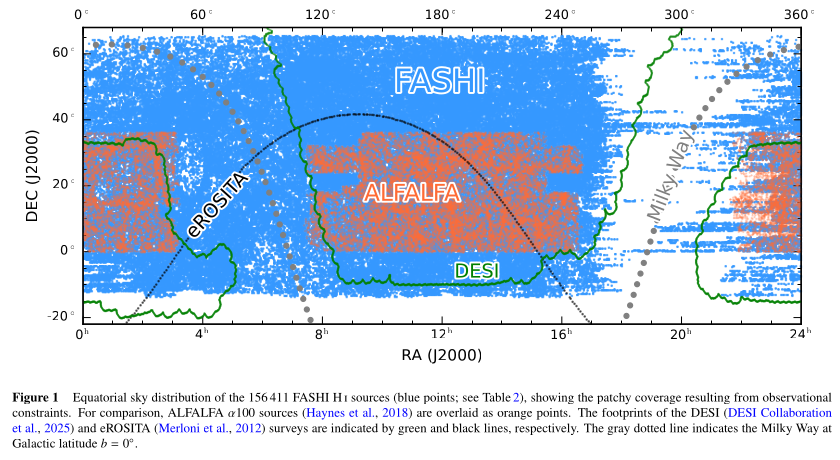
The survey is designed to map the entire sky accessible to FAST, covering declinations from −14° to +66° (~22,000 deg²) in the frequency range 1.0–1.5 GHz. As of the second data release (DR2), FASHI has mapped approximately 19,500 deg² of the sky, detecting over 156,000 extragalactic H I sources — making it the largest and most sensitive H I survey ever conducted.
Survey Strategy and Observations
FASHI adopts a flexible drift-scan observing strategy, optimized for FAST's schedule-filler observing mode. Observations are carried out at fixed declinations, enabling an efficient blind search for H I emission while maximizing the utilization of available telescope time. This strategy naturally leads to non-uniform sky coverage, with some regions observed multiple times and thus reaching greater sensitivity.
The survey utilizes FAST's 19-beam receiver array, with a half-power beamwidth of 2.9 arcmin at 1.4 GHz and pointing accuracy better than 15 arcsec. The spectral backend provides 500 MHz bandwidth with 64k channels, yielding a native resolution of 7.63 kHz (~1.6 km s−1 at 1.4 GHz). Data are recorded at 1-second integrations. Intensity calibration employs periodic noise-diode injections, with a beam-dependent gain of 13–17 K Jy−1 at 1400 MHz.
Data Releases
FASHI has released two major data releases, each representing significant milestones in the survey's progress and scientific impact.
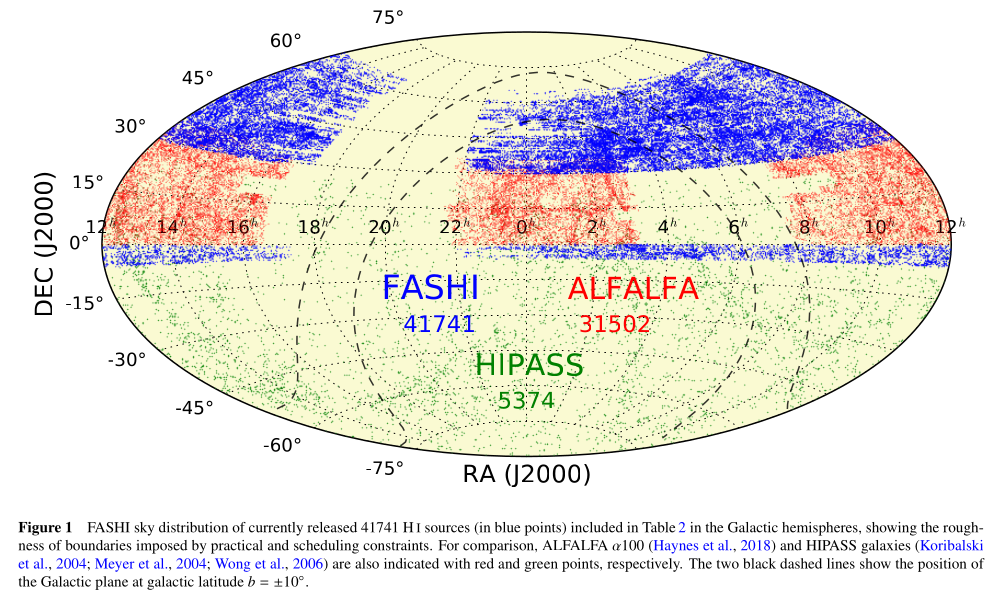
FASHI DR1 (2024): The First Release of Catalog
FASHI DR2 (2026): The FASHI Catalog and the H I Mass Function
Accessing FASHI Data
In addition to the catalog listed in the DR2 Technical Details table, integrated one-dimensional H I line spectra for all cataloged sources have been extracted from the reduced three-dimensional FITS data cubes. The full FASHI H I source catalog will be made publicly available upon publication of this paper.
The reduced one-dimensional spectral cubelets associated with individual sources are available upon request from the corresponding authors. Access to the reduced three-dimensional data cubes is currently restricted to internal collaboration use; however, a limited subset of these data may be provided upon reasonable request for specific scientific purposes.
All raw observational data from the FASHI project will be released to the public following a twelve-month proprietary period, in accordance with the FAST data release policy. The twelve-month proprietary period applies to each individual scan observation, rather than to the completion of the full survey.
FAST Data Policy Summary:
- Proprietary Period: 12 months from the date of data collection for PI-time projects and priority/key science projects.
- Data Access During Proprietary Period: External researchers may apply to the project PI or the FAST Scientific Committee for access to data during the proprietary period for collaborative or independent research.
- Data Release After Proprietary Period: Data are publicly released by the FAST Operation and Development Center after the proprietary period and can be used without restriction.
- Data Transfer: Due to bandwidth limitations, it is encouraged to make direct copies of released FAST data using hard disks at the FAST Data Center.
- Acknowledgment: Publications using FAST data must include the proper acknowledgment: "This work has used the data from the Five-hundred-meter Aperture Spherical radio Telescope (FAST). FAST is a Chinese national mega-science facility, operated by the National Astronomical Observatories of Chinese Academy of Sciences (NAOC)."
Further details regarding FAST data access and release policies are available at FAST Data Policy.
FASHI DR1 Supplementary Materials
- The full paper can be downloaded in The FAST All Sky HI Survey (FASHI): The First Release of Catalog
- The complete Table 2 containing 41,741 sources can be accessed in FASHI Extragalactic H I Source Catalog
- The complete Table 3 containing 3,620 sources can be accessed in FASHI and ALFALFA Cross-Matching Catalog
- The complete Table 4 containing 14,072 sources can be accessed in Identified Optical Counterparts from the SGA Catalog
- The complete Table 5 containing 2,900 sources can be accessed in Identified Optical Counterparts from the SDSS Spectroscopic Catalog
- The complete Table 6 containing 10,975 sources can be accessed in Identified Optical Counterparts from the SDSS Photometric Catalog
FASHI DR2 Supplementary Materials
- The full paper can be downloaded in The FAST All Sky H I Survey DR2: the FASHI Catalog and the H I Mass Function
- The complete Table 2 containing 156,411 sources can be accessed in FASHI DR2 Extragalactic H I Source Catalog
- The complete Table 3 containing 28,352 sources can be accessed in Cross-matched catalog of FASHI and ALFALFA sources
FASHI DR2 Technical Details
| Parameters | Values |
|---|---|
| RA range | 0h ≤ RA ≤ 24h |
| DEC range | −14° ≲ DEC ≲ +66° |
| Receiver | 19-beam array |
| Polarizations per beam | 2 linear (XX, YY) |
| Beam size (FWHM) | 2.9 arcmin at 1420 MHz |
| Gain | 13–17 K Jy−1 |
| Tsys | 16–19 K |
| Total frequency coverage | 1050–1450 MHz |
| Released frequency range | 1305.7–1422.8 MHz |
| cz⊙ range | −510.0 to 26320.6 km s−1 |
| Redshift z range | z < 0.0878 |
| Spectral channels | 65,536 (before smoothing) |
| Channel spacing | 7.629 kHz or 1.6 km s−1 at 1420 MHz |
| Spectral resolution | 6.4 km s−1 (after smoothing) |
| Median rms σrms | ~1.04 mJy at 6.4 km s−1 resolution |
| Median sensitivity fσ | ~0.57 mJy beam−1 at 6.4 km s−1 resolution |
| Coverage area | 19,500 deg2 |
| Source number | 156,411 |
Notes: The definitions of the spectral rms σrms and the per-source detection sensitivity fσ are provided in Column 9 of Section 2.4.
Source Extraction
Source extraction for FASHI employs a two-step approach combining automated detection with visual validation:
- Blind detection: Initial candidates are identified using SoFiA (Serra et al. 2015; Westmeier et al. 2021) with a 4.5σ detection threshold, which was empirically chosen to provide the optimal trade-off between completeness and reliability.
- Optically guided extraction: Given the substantial sky overlap (>12,000 deg²) between FASHI and DESI/SDSS spectroscopic surveys, optical data are leveraged to complement source extraction and improve sample completeness. For each optical counterpart, an emission signal exceeding 3σ is required for detection.
- Visual validation: All candidates are inspected interactively using moment maps and integrated profiles to reject false detections and refine source boundaries.
Important Publications Related to FASHI
News Related to FASHI
- 【新闻直播间】中国天眼构建世界最大中性氢星系样本库
- 【午夜新闻】中国天眼构建世界最大中性氢星系样本库
- 【中国科学院】中国天眼构建世界最大中性氢星系样本库
- 【中国新闻网】“中国天眼”构建世界最大中性氢星系样本库 绘就最大宇宙气体图谱
- 【科学网】中国天眼绘就最大宇宙气体图谱
- 【国家天文台】从追光者到掌灯人,FAST绘就最大宇宙气体图谱
- 【新华网】十载望星河 中国天眼重绘宇宙演化图景
- 【国家天文台】恒星的迟暮与未尽的氢海:中国天眼重绘宇宙演化图景
- 【中国日报网】恒星的迟暮与未尽的氢海:中国天眼重绘宇宙演化图景
- 【新华鲜报】十载望星河 中国天眼重绘宇宙演化图景
- 【科学网】中国天眼探测并构建世界最大的中性氢星系样本
- 【贵大新闻网讯】贵州射电天文台参与中国天眼探测 构建世界最大的中性氢星系样本
- 【CCTV】中国天眼最新巡天成果发布 探测并构建世界最大中性氢星系样本
- 【Xinhua】Chinese Scientists Build Largest-Ever Neutral Hydrogen Catalog in Deep Space
- 【知乎】中国天眼探测并构建世界最大的中性氢星系样本,这一巡天成果有哪些意义?
- 【虚拟天文台】中国天眼(FAST)中性氢巡天源表:首次发布
- 【新华网】点赞科技“热词”丨2023那些振奋人心的科技成果
- 【EurekAlert】FASHI Releases the Largest Extragalactic H I Catalog with FAST

© FASHI Collaboration · FAST Operation and Development Center, NAOC